The Aircraft
The aircraft that never has to keep moving.
Every fixed-wing aircraft ever built has a speed below which it stops flying. Aurora doesn't. That single fact changes what an aircraft can do for an audience on the ground.
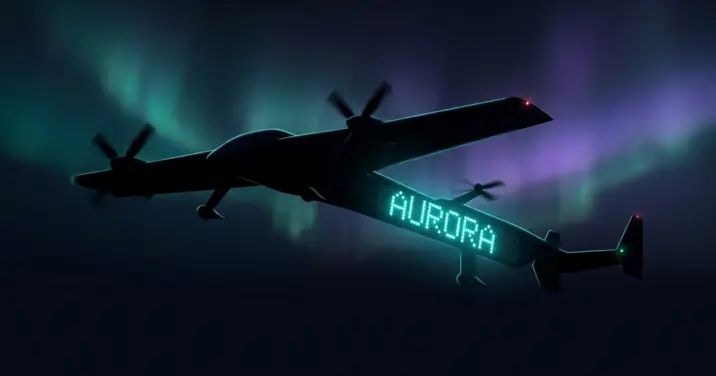
Zero Stall Speed
Slow is not a failure state.
On a conventional airplane, slowing down is a countdown. Below a certain airspeed the wing stops lifting, and the aircraft stops flying. Pilots call it the stall, and entire libraries of training exist to keep them away from it.
Aurora's wings rotate — with the motors mounted to them. As the aircraft slows, the wings tilt upward and the propellers take over exactly as much lift as the wing gives up. Slow to walking pace, or to a standstill, and the aircraft is simply flying on its motors, wings vertical, as stable as it was at cruise.
There is no cliff. There is no countdown. Speed becomes a creative decision, not a survival constraint.
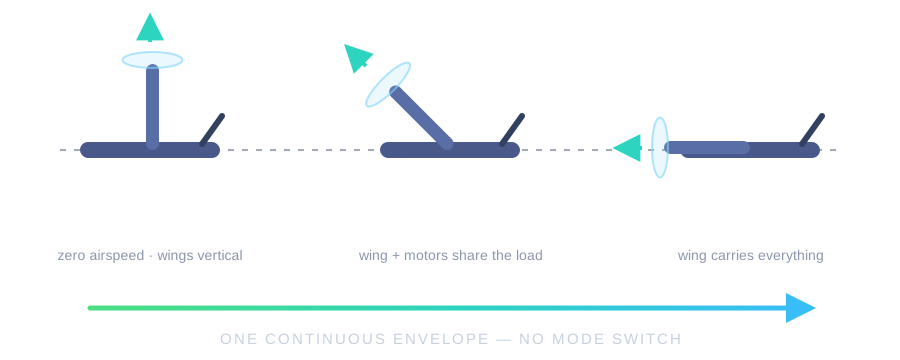
The full spectrum is normal flight. The aircraft picks the blend; nobody has to.
One Continuous Mode
Other VTOLs cross the gap. Aurora abolished it.
Conventional VTOL aircraft carry two personalities: a "copter mode" for takeoff and a "plane mode" for travel. Between them lies the transition — a window where the aircraft is neither one thing nor the other, and which pilots are trained to get through as decisively as possible.
Aurora was designed from the first sketch to make that window its home. Its flight control blends motor lift and wing lift as one continuous system, so the aircraft holds any point on the spectrum indefinitely — a fast hover, a slow cruise, and every useful speed in between. What other platforms treat as their most dangerous seconds, Aurora treats as its operating envelope.
The result is an aircraft that flies at the speed of its audience: zero over a stadium bowl, walking pace beside a boardwalk crowd, full cruise between venues.
Level by design
Airplanes pitch their nose to climb and descend. Aurora doesn't need to — the wings rotate instead, so the fuselage stays level from a standstill to full cruise.
For an advertising aircraft, that's not a nicety. It means the display presents itself squarely to the audience at every speed, in every maneuver.
At home in the wind
Aurora is an airplane at heart, and it behaves like one in weather: it naturally turns its nose into the wind and lets the wing work, rather than fighting gusts with raw thrust the way a multirotor must.
A breezy evening at the shoreline is a normal operating day, not a cancellation.
Endurance where it counts
A wing generating lift is dramatically cheaper than rotors fighting gravity. Aurora leans on its wing at every speed where the wing can help — which is every speed above a standstill.
That efficiency converts directly into what advertisers actually buy: time in front of the crowd.
All-electric
Electric propulsion, no fuel, no exhaust. Because the wing shares the work, Aurora spends most of its show at a fraction of hover power — the quiet end of its range.
The audience hears the concert, not the aircraft.
A Family, Not a One-Off
Every Aurora is generated, not drafted.
Aurora isn't a single hand-built airframe — it's a design system. The aircraft's geometry, physics, and safety constraints live as code, and every variant is generated, checked against the platform's invariants, and validated before a single part is cut.
Need a bigger display for a stadium? A more compact aircraft for a private event? The airframe is re-sized around the payload and re-verified automatically — the same proven control architecture, tailored to the mission.
It's how a focused engineering team ships like a large one: the design knowledge is in the system, not in a filing cabinet.
Platform at a glance current development airframe
- Configuration
- Tilt-wing, twin tilting motors + twin rear motors
- Minimum airspeed
- 0 — sustained hover
- Wing tilt range
- Vertical to horizontal, continuous
- Payload fraction
- Roughly one-third of takeoff weight
- Propulsion
- All-electric
- Display payload
- Towed full-color LED matrix, 2,560 pixels
- Telemetry & Ground Control
- MAVLink telemetry via MAVLink HUD
- Sizing
- Parametric — scaled to display & venue
Want the deeper story?
How we deleted the stall, why the transition shouldn't exist, and what a software-defined airframe actually means.