Technology
Flight, without the cliff.
Aurora is built on a simple conviction: the most dangerous moment in VTOL flight — the transition — shouldn't be a moment at all. Here's the thinking, in plain language.
01 — The Problem
Every wing has a floor
A wing makes lift from moving air. Fly too slowly and the airflow can no longer follow the wing's surface — lift collapses, and the aircraft falls until it regains speed. That's a stall, and it defines a hard floor under every conventional airplane's flight envelope.
For most aviation, the answer is simple: stay fast. But an advertising aircraft earns its living at exactly the speeds a wing hates — drifting past a boardwalk, holding over a stadium, matching the pace of a crowd. A conventional airframe is the wrong tool for the job, by physics, not by engineering shortfall.
02 — The Industry's Answer
Two aircraft in one body — and a seam between them
The VTOL industry's standard solution is to bolt two aircraft together: rotors for hovering, a wing for cruising, and a switch between "copter mode" and "plane mode." It works — but the seam never disappears. During the transition, the aircraft is half of each thing: too slow for the wing to lift confidently, its rotors losing authority as the airflow changes around them.
The operational guidance across the industry is telling: get through the transition quickly and decisively. It is treated as a corridor to be crossed, never a place to operate. Which means the very regime an advertising aircraft needs to live in — slow, low, deliberate — is the one regime conventional VTOLs are engineered to escape.
03 — The Aurora Way
Thrust points where lift is missing
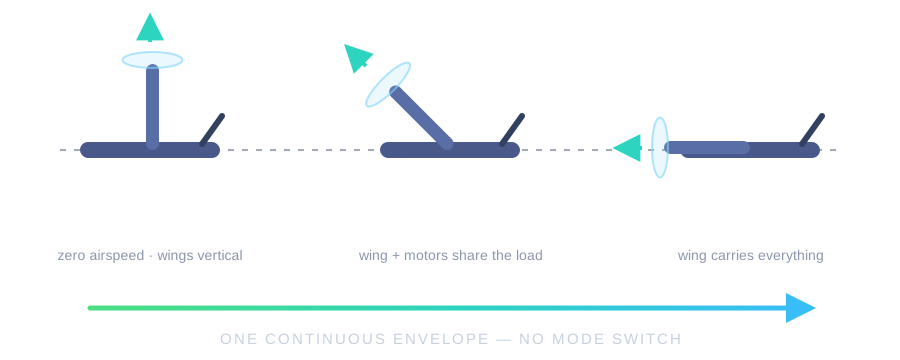
Aurora's wings rotate on a servo-driven axis with the motors mounted to them. When the wing can't provide lift — because the aircraft is slow — the wing tilts up and the propellers provide it instead. The two lift sources trade off along a smooth, continuous curve, and the flight control system chooses the operating point automatically, moment by moment.
Because the motors tilt with the wing, the propellers always work in clean air and the wing always sits correctly in the propellers' flow. There is no regime where one half of the aircraft fights the other — which is precisely the disease of the two-mode design.
The behavior that falls out is remarkable to watch: as Aurora slows, the wings simply rise to meet the moment. Nothing switches. Nothing hands off. It is one aircraft, at every speed, including zero.
04 — The Stable Stage
The airframe holds the stage level
Conventional aircraft steer their speed and altitude by pitching the whole airframe — nose up to climb, nose down to descend. Aurora's control system takes a different bargain: it steers by re-aiming the thrust instead, and dedicates its aerodynamic surfaces to a single job — keeping the fuselage level.
That priority was chosen deliberately. Aurora is a stage for a message. A display that pitches and rolls with every correction is harder to read and looks nervous; one that glides dead-level through accelerations, climbs, and gusts looks inevitable. Stability isn't a byproduct of our design — it's the specification everything else serves.
05 — The Design System
The software-defined airframe
Behind every Aurora is a design pipeline, not a drawing board. The aircraft's geometry is expressed as parametric code; its hard-won design rules — where the motors may sit, how the wing may scale, where the balance must fall — are encoded as automated constraints that fail loudly if a variant violates them.
Change one number — a wingspan, a payload mass — and the entire aircraft is regenerated: structure, balance, aerodynamic analysis, and manufacturing files, every constraint re-checked along the way. What took an engineering department a design cycle now takes the system minutes, with the platform's full accumulated judgment applied every single time.
This is why Aurora is a family rather than a prototype: scaling to a new venue or payload isn't a redesign. It's a regeneration.
06 — Ground Operations
MAVLink Telemetry & Live Monitoring
Aurora communicates with the ground crew via a real-time, ultra-reliable MAVLink telemetry protocol stack. Every critical flight parameter — wing tilt angle, motor RPMs, battery state, synthetic pitch/roll vectors, and EKF3 position estimates — is broadcast continuously over long-range wireless links.
On the ground, flight safety officers monitor the mission live using MAVLink HUD, our custom Android heads-up ground station software. With high-contrast artificial horizon overlays, parameter tuning, and instant telemetry diagnostics, the crew maintains 100% situational awareness throughout hover, transition, and low-altitude venue operations.
06 — Safety
Safe because of the architecture, not despite it
Most aircraft safety is about keeping away from edges — stall speed on one side, transition corridors on another. Aurora's architecture removes the edges themselves:
- Losing airspeed is self-correcting. If the aircraft slows or the nose rises, the wings tilt proportionally toward hover and motor lift fills in — a continuous response, not an emergency procedure.
- There is no failover moment. With no mode switch, there is no split-second handoff to get wrong, no window where the aircraft is between identities.
- The weather works with us. Like any well-mannered airplane, Aurora naturally faces into the wind and lets the wing carry the load — the calm response, not the brute-force one.
Every flight is operated by our crew, inside the applicable aviation regulations, with the venue and airspace coordinated in advance.
The physics is the pitch.
An aircraft that flies at your audience's speed, carrying a display built for the dark. See what a show looks like.